
How to Choose a 3PL in Europe (2026 Guide)
Seven steps to pick a 3PL in Europe: the customs border, the country, store connections, product rules and VAT, with the questions to ask each provider.
 By Andrew Calloway, editor
Published October 5, 2026 · Updated October 9, 2026
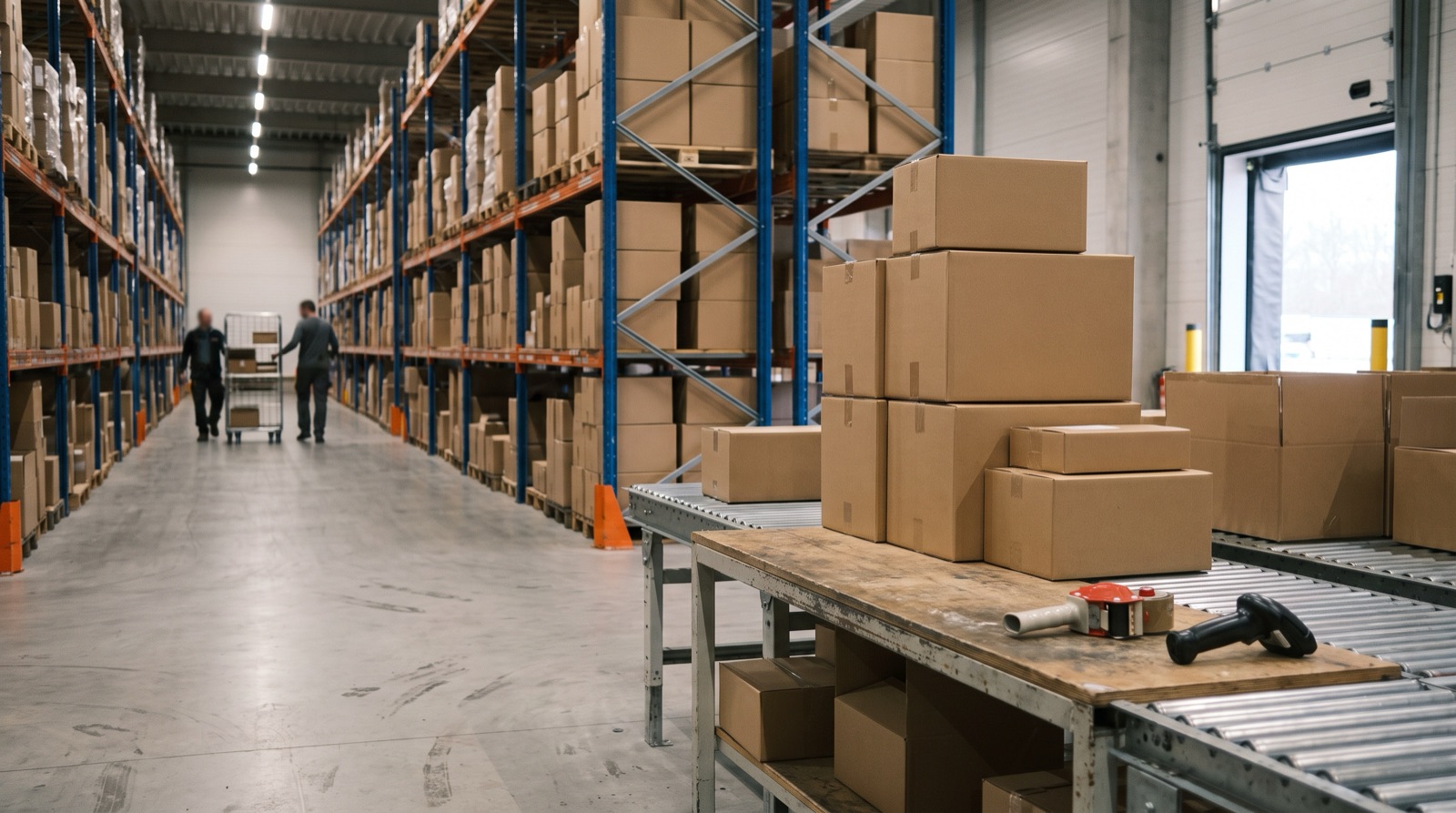
Choosing a 3PL Europe can rely on comes down to seven decisions, and the first one is not about warehouses at all. It is about a line on the map. Since 1 July 2026 the EU charges a customs duty of EUR 3 per item on parcels worth EUR 150 or less, which used to enter duty free, so shipping each order from home has become harder to defend. Holding stock inside Europe replaces thousands of small imports with a few large ones.
That is the case for a European fulfillment partner if you sell from the United States, the United Kingdom or Australia. A single-site provider such as 3PL Service Netherlands, an ecommerce fulfillment company in Assen that builds its service around US, UK and Australian brands shipping into the EU, shows the model: one stock pool inside the customs union, serving customers across the member states.
Here is the short version of the steps:
- Decide which side of the customs border your stock sits on.
- Pick the country that matches where your goods arrive and where your customers are.
- Check that the provider connects to the way you sell.
- Match the provider to your order volume and your products.
- Settle customs, VAT and duty before the first pallet ships.
- Ask about returns and the services around the order.
- Build a shortlist and run a trial.
By the end you will have a shortlist of two or three providers and the questions to put to each of them.
What you’ll need before you start
Three numbers and one list. Know your monthly order volume in Europe, even if it is an estimate. Know how many products you would send over. Know which countries most of your European orders go to. Then list the store platform and marketplaces you sell on.
Providers will ask for all four on the first call. Having them ready turns a sales conversation into a useful one.
Step 1: Decide which side of the customs border your stock sits on
Start by choosing between stock inside the EU and stock outside it. The 27 EU member states form a customs union. Goods that clear customs once on entry circulate freely within the EU, with no customs duties at the borders between member states. One warehouse inside that union can reach customers in all of them.
The United Kingdom, Switzerland and Norway are outside it. The UK left the EU single market and customs union, and goods moving between Great Britain and the EU now need customs declarations in both directions.
So the question is where your orders go. If most of them go to British addresses, stock in Great Britain avoids a customs border on every parcel. Jet Group in Woodbridge, Suffolk, is one example of a UK provider: it combines ecommerce fulfilment with its own courier fleet and connects to Shopify, WooCommerce, Amazon and eBay. If most of your orders go to Germany, France or the Netherlands, stock inside the EU does the same job there.
A brand with real volume on both sides can run two providers, one in the EU and one in the UK. Decide this first. You should now know which you need: an EU provider, a UK provider, or one of each.
Step 2: Pick the country for your 3PL Europe base
Choose the country by where your goods land and where your buyers live. Three countries lead the search results on this topic, and each has a different case.
The Netherlands
Goods arriving by sea often land here. Eurostat calls Rotterdam “the largest port in Europe”, with 397 million tonnes handled in 2024, and names it the EU’s largest container port. Amsterdam Schiphol was one of five EU airports that handled more than 1 million tonnes of freight and mail in 2024.
The Netherlands also has a specific import VAT mechanism. With an Article 23 permit, VAT on import is accounted for in the VAT return and is not paid at the border. A foreign business cannot apply for the permit itself, but it can engage a tax representative who can. Ask any Dutch provider how its clients handle this, and have a tax adviser confirm what applies to you.
Dutch providers are used to serving several countries from one site. 3PL Service Netherlands, for one, ships from Assen across the Netherlands, Germany, Belgium, France and the wider EU, and connects to Shopify, WooCommerce, Magento, BigCommerce and Lightspeed. You can compare fulfillment companies in the Netherlands side by side.
Germany
Germany suits brands whose buyers are mostly German. German airports handled the highest volume of freight and mail in the EU in 2024, at 4.7 million tonnes, and Frankfurt Main was the largest EU airport for freight and mail, according to Eurostat. Hamburg was the third-largest EU port by tonnage that year. The standard VAT rate is 19%. See the providers in Germany.
Poland
Poland is the country the current top-ranking provider page argues for, as a base for cross-border direct to consumer shipping into Germany and beyond. Omnipack, a Warsaw fulfillment operator, is an example: it handles pick and pack, returns, B2B orders for retailers and marketplaces, and cross-border shipping, with support for VAT registration and customs clearance. Poland is in the EU but uses the zloty, and its standard VAT rate is 23%. See the providers in Poland.
If none of the three fits, the country-by-country list for Europe covers 30 countries. You should now have one country, or two, to search in.
Step 3: Check that the provider connects to the way you sell
Confirm the connection to your store before you compare anything else. A provider that cannot receive your orders automatically will cost you hours every day.
Ask which of these it supports today, not on a roadmap:
- Store platforms: Shopify, WooCommerce, Magento, BigCommerce or your own system through an API.
- Marketplaces: Amazon and the European marketplaces you plan to sell on.
- Warehouse system: the WMS you will log in to, and whether it shows stock and order status in real time.
The connection is not the same everywhere. Some providers publish their own app. Others connect through their warehouse system or build the link to order. Active Ants processes orders in automated fulfilment centers where staff work alongside robots, and gives clients its own Maya WMS for real-time order status, stock and returns.
The directory groups providers by what they state they support. Start with the Shopify fulfillment companies or the Amazon and marketplace fulfillment companies. You should now have crossed off every provider that cannot take your orders directly.
Step 4: Match the provider to your order volume and your products
Tell each provider your monthly order volume up front and ask whether you fit. Some set an order minimum. Some are built for large accounts and will treat a small brand as an afterthought. Ask for the size of the smallest and the largest client, and ask how they staff for peak demand.
Then check that they can take your products. Three rules catch overseas brands out:
- Cosmetics. Under Regulation (EC) No 1223/2009, a cosmetic product can be placed on the EU market only if a responsible person is designated within the EU, and the product is notified through the EU’s cosmetics portal.
- Food supplements. Directive 2002/46/EC lets each EU country require notification to its own authority, so the steps differ by country.
- Most consumer products. Since 13 December 2024 the General Product Safety Regulation requires a responsible economic operator in the EU, and it names fulfilment service providers among those who can fill that role.
A warehouse does not take on these duties by storing your stock. Ask each provider which it covers and which stay with you. The cosmetics and supplement fulfillment companies are a starting point if your products fall under the first two.
You should now know which providers fit your size and can legally handle what you sell.
Step 5: Settle customs, VAT and duty before the first pallet ships
Get the paperwork answered in writing before stock leaves your country.
Three facts frame the conversation:
- EORI. A business not established in the EU needs an EORI number if it lodges a customs declaration there. It requests the number from the customs authority of the EU country where it first declares.
- Import VAT. Since 1 July 2021 all goods imported into the EU are subject to VAT, whatever their value.
- Bonded storage. Customs warehousing lets non-EU goods sit in an authorized warehouse without import duties being due until they are released into the EU. That suits a brand that brings stock in before it knows where it will be sold.
Then put four questions to every provider. Who is the importer of record when my stock arrives? Who pays the import VAT, and how is it recovered? Which registrations do you expect me to hold before the first shipment? Do you run a bonded warehouse or work with a customs partner?
The directory lists the companies that state they operate a bonded warehouse. The answers on tax depend on your own business, so have a tax adviser confirm them. You should now have each provider’s answers on customs in an email, not from a phone call.
Step 6: Ask about returns and the services around the order
Find out what happens after the parcel leaves, because that is where providers differ most. Ask how a return is checked, what decides whether it goes back on the shelf, and how it is reported to your store.
Then ask about the services your market needs. If you sell into the Balkans or Central and Eastern Europe, ask about cash on delivery. euShipments, based in Ruse, Bulgaria, is one provider that offers it: it runs cross-border fulfillment with cash on delivery, customs clearance and returns handling, and combines a network of fulfillment centers across Europe under one contract.
Other services to ask about are kitting, relabeling, customizable packaging and B2B orders for retailers. Not every brand needs them. Pay for the ones you will use.
You should now know what each provider does beyond pick and pack.
Step 7: Build your shortlist and run a trial
Cut the list to two or three providers and test before you commit. A short trial with part of your stock tells you more than any sales call.
Build the shortlist from providers that passed every earlier step. The page for EU fulfillment for US, UK and Australian brands lists the companies that state they work with brands from outside the EU, which is a useful filter if you are new to the market.
Then run the same test with each one. Send a small inbound shipment. Place ten orders to different countries yourself. Return two of them. Watch how long each stage takes, how the tracking reads to a customer, and how fast someone answers when something goes wrong.
Ask to visit before you sign. A provider that is proud of its warehouse will say yes. You should now have one provider you trust and a second you could move to.
Common mistakes
Four mistakes to avoid when you pick a European provider from overseas.
- Choosing on the map alone. A central location means little if the provider cannot connect to your store or handle your product type.
- Leaving customs for later. Stock that arrives before the importer of record and VAT questions are settled can sit at the border.
- Treating the UK as part of the EU. It is a separate customs territory. Plan for it as one.
- Reading ratings without the count. A 5.0 from six reviews tells you less than a 4.6 from three hundred. Read a few reviews before you lean on the number.
FAQ
Who are the big 3 in Europe?
By revenue, the three largest Europe-based 3PLs are DSV of Denmark, DHL Supply Chain & Global Forwarding of Germany and Kuehne + Nagel of Switzerland, according to Armstrong & Associates’ 2026 list, which ranks providers by 2025 gross logistics revenue. The ranking measures size, not fit for a brand placing its first European stock.
What are the top 5 logistics companies in Europe?
Armstrong & Associates’ 2026 ranking of Europe-based 3PLs puts DSV first, followed by DHL Supply Chain & Global Forwarding, Kuehne + Nagel, CEVA Logistics and Maersk Logistics. The list is ordered by 2025 gross logistics revenue. All five are global logistics groups.
What is 1PL, 2PL, 3PL, 4PL, and 5PL logistics?
The numbers describe how much of the logistics work is outsourced. A 1PL moves its own goods. A 2PL is a carrier that transports them. A 3PL stores stock and fulfills orders for you. A 4PL manages several 3PLs on your behalf, and 5PL usually describes a provider running whole supply networks.
What are the benefits of a 3PL logistics partner for ecommerce brands?
A 3PL gives a brand warehouse space, staff, a warehouse system and carrier contracts without building any of them. For a brand entering Europe, the main gain is stock held close to the customer and inside the customs border, so each order ships as a domestic parcel and not as an import.
Verdict: the 3PL Europe decision in one line
Pick the customs territory first, then the country, then the provider. Doing it the other way round risks stock held at the border.
If your European buyers are spread across the EU and you want one site to serve them, start with a single-warehouse provider inside the customs union. Look at the Netherlands first if your goods arrive by sea through Rotterdam. If Germany is most of your market, look there. If your buyers are British, you need a UK provider, and possibly a second one in the EU.
Whatever you choose, get the customs answers in writing and run a trial with real orders before you move all your stock. Your next step is to open the list of fulfillment companies in Europe, filter to the country you chose in step 2, and contact three providers with the four numbers from the start of this guide.