
Pick and Pack Fulfillment Explained: Order to Parcel (2026)
How pick and pack works at a 3PL: receiving, storage, picking methods, packing, labels, carrier handover and returns, plus the line items a quote contains.
 By Andrew Calloway, editor
Published October 5, 2026 · Updated October 9, 2026
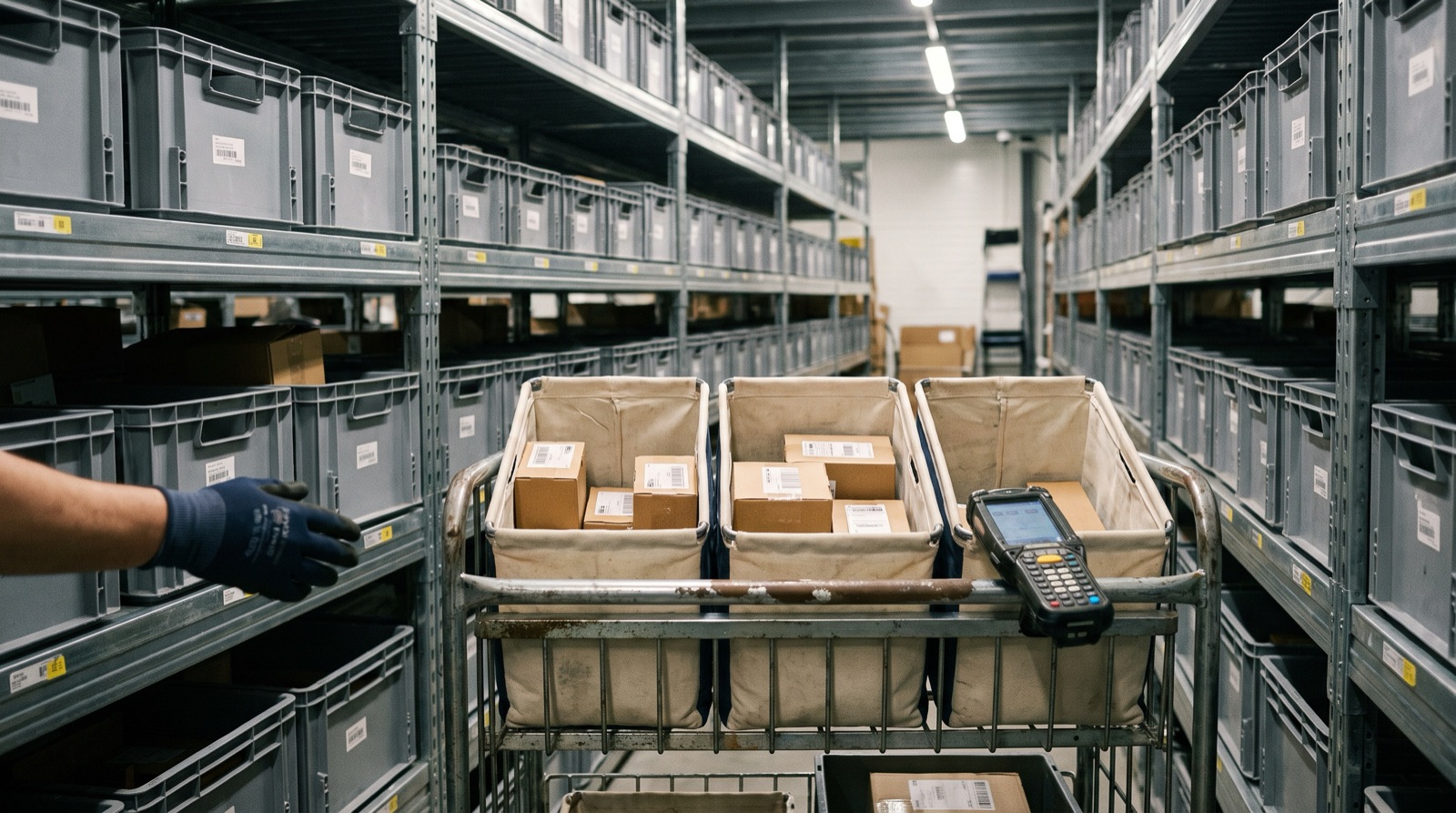
Pick and pack is the warehouse work that turns an online order into a sealed, labeled parcel. A staff member or a robot takes the ordered items from storage, checks them, packs them in a box or mailer, and hands the parcel to a carrier. It sounds simple. The details decide whether your customer gets the right item in a box that fits.
If you sell from the United States, the United Kingdom or Australia and plan to hold stock in Europe, this is the service you are buying from a European fulfillment company. Below: each step from order to parcel, the four main picking methods, how a quote is put together, and the questions that separate one provider from the next.
Pick and pack fulfillment covers everything between an order arriving and a parcel leaving: receiving and storing your stock, picking the ordered items, packing and labeling them, and handing them to a carrier. Returns usually run through the same team. Providers pick in four main ways (single order, batch, zone and wave) and charge per activity, so ask each one for an itemized quote and test it with real orders.
What’s new in 2026: EU packaging rules reach the packing bench
The EU’s packaging law now applies. Regulation (EU) 2025/40 on packaging and packaging waste entered into force on 11 February 2025 and applies from 12 August 2026.
One article in it is aimed squarely at fulfillment. Article 24 says economic operators who fill grouped, transport or e-commerce packaging must keep the empty space ratio to a maximum of 50%. That obligation starts on 1 January 2030, or three years after the Commission adopts its calculation method, whichever is later. The Commission has until 12 February 2028 to adopt that method.
So the rule is dated but not yet in force. Ask any provider how it chooses box sizes today and how it plans to measure empty space once the method is published. Who counts as the “economic operator” for your parcels is a legal question, so confirm it with an adviser.
What pick and pack means in a fulfillment warehouse
In a pick and pack warehouse, orders are built item by item from stored stock. That is the difference from pallet distribution, where whole pallets or cartons leave the building unopened. Ecommerce orders are small and varied, so each one has to be assembled by hand or by machine.
EU law has its own name for a company that does this work for others. Regulation (EU) 2019/1020 defines a fulfilment service provider as a business offering at least two of four services (warehousing, packaging, addressing and dispatching) without owning the products. Postal, parcel delivery and freight transport services are excluded. A courier is not a fulfillment provider under that definition.
Of the 1,665 companies listed in this directory, 1,286 state that they store stock and pick, pack and ship online orders for other businesses. The others either do different work, such as freight or pallet storage, or have not said either way.
The pick and pack process, step by step
Every provider runs the same core sequence, though the tools differ. Here is what happens to your stock and your orders.
1. Receiving
Your inbound shipment arrives as pallets or cartons. The warehouse counts it against your advance shipping notice, checks for damage and records each SKU in its warehouse management system (WMS). Mistakes made here follow every order that ships later, so ask how discrepancies are reported to you.
2. Storage
Stock goes to a location: a pallet rack, a shelf, a bin or an automated storage grid. Fast-moving products usually sit closest to the packing area. The WMS links each SKU to its location, so pickers are sent to the right place.
3. Order arrival
Your store or marketplace sends the order to the provider’s system through an integration. If the link is broken, nothing ships. That is why the connection matters before anything else. The directory lists Shopify fulfillment companies separately, as 466 listed companies name Shopify as a supported platform.
4. Picking
The system creates a pick list. A picker, a robot or a goods-to-person system collects the items. Scanning each barcode confirms that the right SKU and quantity were taken.
5. Packing
The packer checks the items against the order and chooses a box, mailer or bag. Then come the void fill, any inserts you supply and the seal. This is where your brand’s unboxing happens and where the packaging rules above will bite.
6. Labeling and carrier handover
The system prints the shipping label for the chosen carrier and service. Parcels are sorted by carrier and loaded when the carrier collects. Tracking details go back to your store, which sends them to the customer. Ask for the provider’s daily cut-off time for orders to ship the same working day.
7. Returns
Returns are part of pick and pack, not an extra. In the EU, an online buyer generally has the right to cancel within 14 days without giving a reason, counted from delivery for goods. A returned item is received, inspected and either restocked, set aside or written off according to your rules. Of the companies listed here, 967 state that they process returns for clients.
Pick and pack methods: single order, batch, zone and wave
The picking method shapes how a warehouse handles volume, and many warehouses combine methods.
- Single order picking (also called discrete or piece picking). One picker collects one order at a time, start to finish. It is easy to control and suits low volumes or large, awkward items.
- Batch picking. One picker collects the items for several orders in one trip, then the orders are separated at packing. It cuts walking when many orders share the same products.
- Zone picking. The warehouse is split into zones, and each picker stays in one. An order that spans zones is passed along or consolidated. It suits large warehouses with many SKUs.
- Wave picking. Orders are released in scheduled waves, often grouped by carrier collection time or by shipping service. Waves can be combined with batch or zone picking.
Technology changes how each method runs. Cherrypick Logistics (cherrypicklogistics.com) in Spain states that it uses pick to light and radio frequency picking. QLS (qls.nl) in Dordrecht states that it runs an AutoStore system to speed up picking. Monta’s Papland site (gomonta.com) in Gorinchem lists pick-to-light, a sorting machine and systems for a second quality check and parcel verification. These are examples of the range, not a ranking.
Ask which method the provider would use for your orders, and why. A brand with ten SKUs and single-item orders needs something different from a brand with two thousand SKUs and mixed baskets.
How pick and pack services are charged
Expect a pick and pack quote to be split into line items, with a total that depends on your order profile. Common lines include:
- Onboarding or setup. A one-off charge for account setup, integration and SKU registration, if the provider has one.
- Receiving. Charged per pallet, per carton, per unit or per hour of labor. Loose or unlabeled stock can cost more to receive.
- Storage. Charged per pallet, shelf, bin or cubic meter, for a set period.
- Pick fee. Usually per order, often with a separate charge for each additional item or order line.
- Packing materials. Boxes, mailers, void fill and tape, either included in the pick fee or charged per unit.
- Labels and inserts. Shipping labels, packing slips and any flyers or samples you want added.
- Shipping. The carrier rate for each parcel, by weight, size, service and destination country.
- Returns. A fee per return received and processed, sometimes with a separate charge for inspection or repackaging.
- Value-added services. Kitting, bundling, relabeling or gift wrapping, priced per unit or per hour. In this directory, 855 listed companies state that they offer kitting or another value-added service.
- Account terms. A monthly minimum, a software or integration fee, and any charges for peak periods or special projects.
Two quotes with the same pick fee can produce different monthly totals. Model each quote against a real month of your orders: number of orders, average items per order, average parcel size and the countries you ship to. Fulfillment fees are one part of what an order costs you in Europe. The guide to landed cost covers the duty, VAT and freight that sit on top.
Pick pack and ship in Europe: what changes for overseas brands
For an overseas brand, the packing work is familiar. What changes is where the stock sits. The 27 EU member states form a customs union, and goods that have cleared customs once circulate freely within it, with no customs duties at internal borders. A single warehouse in one member state can ship pick and pack orders to customers in the others without a customs border on each parcel.
Product rules also reach the warehouse. Since 13 December 2024, the General Product Safety Regulation has required a responsible economic operator in the EU for each product it covers, and a fulfilment service provider is one of the four types of operator that can fill that role. A provider does not take it on just by storing your goods. Ask whether it will act in that role and get the answer in writing.
The country-by-country list for Europe shows which providers operate in each of the 30 countries this directory covers. The page on EU fulfillment for US, UK and Australian brands lists the companies that state they work with brands from outside the EU.
Questions to ask a pick and pack provider
Put the same questions to every provider on your shortlist.
- Which picking method would you use for my order profile, and what technology supports it?
- How do you confirm each pick: barcode scan, weight check or a second check at packing?
- What is your daily order cut-off, and what happens to orders that arrive after it?
- Can you send me an itemized quote modeled on one month of my real orders?
- Which packing materials are included, and can I supply my own branded boxes and inserts?
- How do you handle returns, and who decides whether an item is restocked?
- Which store platforms and marketplaces connect directly to your WMS today?
- How do you staff and plan for peak periods such as November and December?
- How will you meet the EU empty space rule for e-commerce packaging once it applies?
Then run a trial. Send a small inbound shipment, place test orders to several countries and return a couple of them. The hub guide to choosing a 3PL in Europe walks through that trial and the rest of the selection process.
FAQ
What does pick and pack mean?
Pick and pack means collecting the items in a customer order from warehouse storage (picking) and placing them in a shipping box or mailer with a label (packing). It is the core service of an ecommerce fulfillment company, usually sold together with storage, shipping and returns.
What is a pick and pack warehouse?
A pick and pack warehouse builds orders from individual items, not from whole cartons or pallets. It stores many SKUs in small quantities, runs a warehouse management system linked to online stores, and has packing stations and carrier collections every working day.
How does pick and pack work?
An order arrives from your store, the system creates a pick list, a picker or robot collects the items, and a packer checks, boxes and labels them. The parcel is handed to a carrier and the tracking number goes back to your store and your customer.
What do pick and packers do?
Pick and packers walk or are routed to storage locations, scan and collect the ordered items, then check them at a packing station, choose the right packaging, add inserts, seal the parcel and apply the shipping label. Some warehouses split picking and packing into separate roles.
Verdict: buy pick and pack on your order profile, not on the headline fee
Pick and pack is a chain of small steps, and each one shows up in the quote and in your customer’s experience. The method, the checks and the packaging choices matter more than the size of the warehouse.
Shortlist two or three providers that connect to your store and handle your product type. Send each the same month of order data and ask for an itemized quote. Then test with real orders before you move all your stock. Your next step is to open the list of fulfillment companies in Europe and compare the pick and pack providers in the country that suits your customers.