
EU Cosmetics Regulation: What Overseas Brands Must Do
What the EU cosmetics regulation asks of US, UK and Australian beauty brands: a responsible person, a safety report, CPNP notification, labels and EU stock.
 By Andrew Calloway, editor
Published October 5, 2026 · Updated October 9, 2026
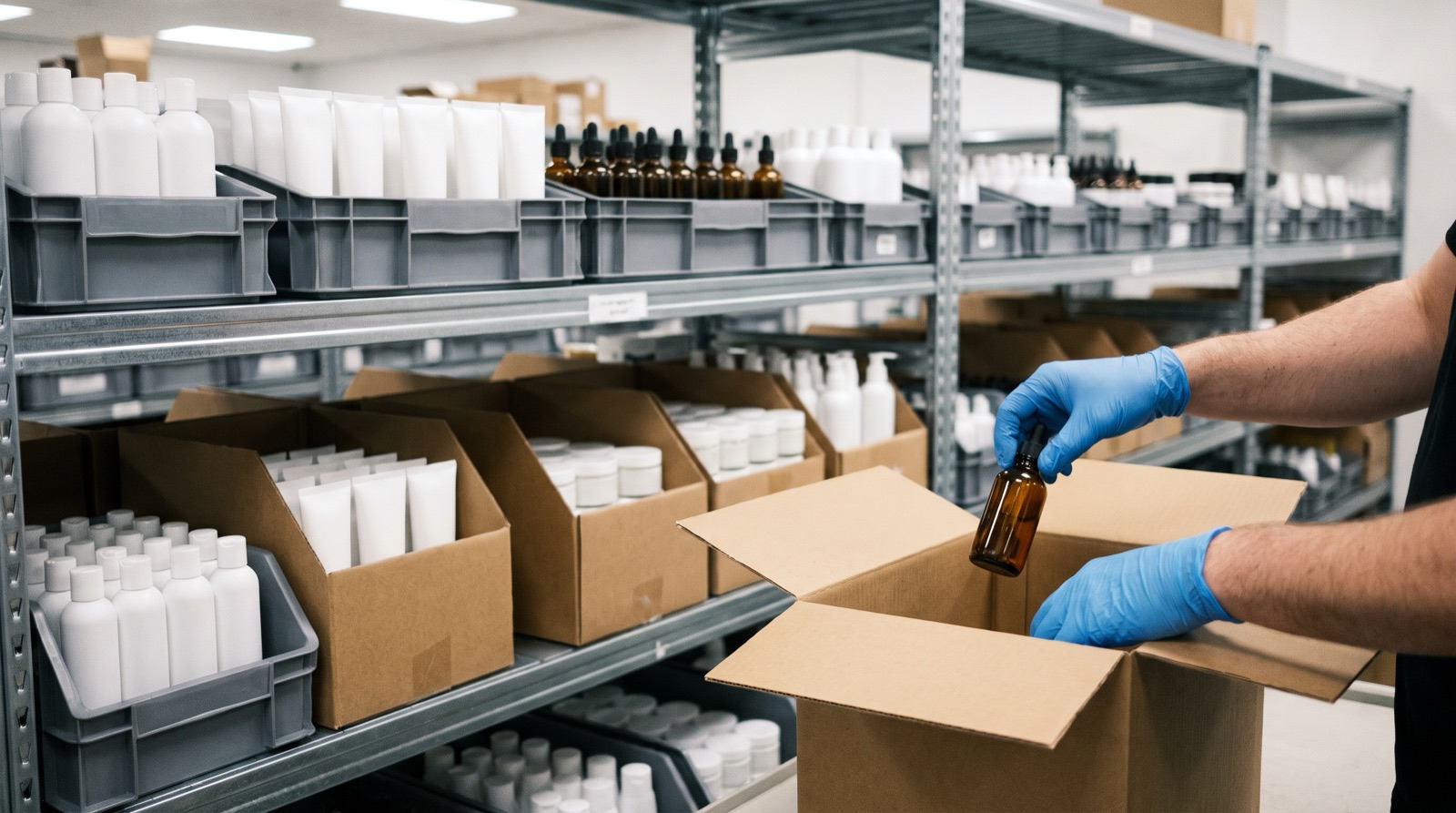
The EU cosmetics regulation decides whether your skincare, makeup or haircare can be sold in the European Union at all, and much of its work happens before the first sale. For a brand based in the United States, the United Kingdom or Australia, the first requirement is a person inside the EU who takes legal responsibility for each product. The safety report, the product file, the notification and the label all follow from that role.
Under the EU cosmetics regulation, a cosmetic product can only be placed on the EU market if a responsible person established in the EU is designated for it. Before the first sale, that person makes sure the product has a safety assessment and report, keeps a product information file, and notifies the product through the EU’s online portal. Labels must name the responsible person. A warehouse does not take on this role by storing your stock.
What the EU cosmetics regulation covers
Regulation (EC) No 1223/2009 is the Commission’s main regulatory framework for finished cosmetic products placed on the EU market. It has applied since 11 July 2013 and is binding in every member state. The articles cited below come from the current consolidated text on EUR-Lex, dated 18 May 2026.
Article 2 covers any substance or mixture meant for the outside of the body, the teeth or the mouth, used mainly to clean, perfume, protect or change the appearance of those parts, keep them in good condition or correct body odors. Anything meant to be swallowed, inhaled, injected or implanted is not a cosmetic, which is why food supplements follow separate rules.
The responsible person: who it can be
Article 4 opens with the rule that matters most to an overseas brand: only cosmetic products “for which a legal or natural person is designated within the Community as ‘responsible person’” may be placed on the market. A company in Los Angeles, Leeds or Melbourne cannot fill that role for the EU itself.
The regulation says who holds it:
- For an imported product, each importer is the responsible person for the product it places on the market (Article 4(5)). An importer here means a person established in the EU who places a cosmetic product from a third country on the EU market.
- By written mandate, the importer can designate another person established in the EU, who must accept in writing.
- A distributor becomes the responsible person if it sells the product under its own name or trademark, or changes it in a way that could affect compliance (Article 4(6)).
That definition of importer is not written in customs terms, so do not assume whoever lodges your customs declaration has accepted this role. The customs side is in our guides to importing into the EU and the importer of record. Other EU product laws use different names for a similar job, compared in our guide to the EU authorized representative.
Article 5 lists what the responsible person answers for, including safety, the safety assessment, the product file, notification, ingredient restrictions, labeling, claims and reporting serious undesirable effects. If a product does not conform, the responsible person must correct it, withdraw it or recall it.
Before the first sale: safety report, product file and CPNP notification
The safety assessment and report
Article 10 requires a safety assessment and a cosmetic product safety report under Annex I before the product goes on sale. Annex I covers, among other items, the product’s composition, its stability and its microbiological quality. The assessor must hold a university qualification in pharmacy, toxicology, medicine or a similar discipline, or an equivalent. The report is kept up to date.
The product information file
Article 11 requires a product information file (PIF) holding a description of the product, the safety report, the manufacturing method with a statement on good manufacturing practice, proof of any claimed effect where justified, and data on any animal testing. It is kept for ten years after the last batch was placed on the market, accessible at the address on the label, in a language the authorities easily understand.
CPNP notification
Article 13 requires the responsible person to submit the product’s details to the Commission electronically before placing it on the market: category and name, the responsible person’s name and address, the country of origin for imports, the member state where it will be placed on the market, a contact person, any nanomaterials, and the frame formulation. The original label and a photo of the packaging follow once it is on sale.
The channel is the Cosmetic Products Notification Portal (CPNP), a free online system. The Commission says that once a product is notified there, no further national notification is needed within the EU.
Labeling rules for cosmetics sold in the EU
Article 19 sets what must appear on the container and packaging, in indelible, easily legible and visible lettering.
| Label item | What the regulation asks |
|---|---|
| Responsible person | Name and address. Imported products also show the country of origin. |
| Nominal content | Weight or volume, with exceptions for packs under five grams or five milliliters. |
| Date of minimum durability | “Best used before the end of” or the Annex VII symbol. Products lasting more than 30 months show the period after opening instead. |
| Precautions | At least those listed in Annexes III to VI. |
| Batch number | The batch number of manufacture or a reference that identifies the product. |
| Function | Unless the presentation makes it clear. |
| Ingredients | Headed “ingredients”, in descending order of weight, using common ingredient names. |
Language is the part that varies. Under Article 19(5), the language of the content, durability date, precautions and function is set by the law of each member state where the product reaches the end user. An English-only box may need a translated label before it is sold in another country. Ingredients use the common names from the Commission’s glossary, so that list does not change.
Fragrance labeling has just tightened. Commission Regulation (EU) 2023/1545 added 56 fragrance allergens to those that must be named in the ingredient list above 0.001% in leave-on products or 0.01% in rinse-off products. Since 31 July 2026, products that do not meet the new rules may no longer be placed on the EU market. Products placed on the market before that date can be made available until 31 July 2028.
Restricted ingredients, animal testing and claims
The annexes, in outline
Article 14 ties the formula to five annexes:
- Annex II lists prohibited substances.
- Annex III lists substances allowed only under stated restrictions.
- Annexes IV, V and VI list the colorants, preservatives and UV filters that are allowed, under their conditions.
The annexes change often: the Commission’s legislation page lists two amending regulations from 2026 alone. Its CosIng database is a useful lookup, but the Commission says it has no legal value. Your safety assessor should check the current text.
The animal testing ban
Article 18 bans testing finished cosmetic products and their ingredients on animals in the EU, and bans marketing products whose formula or ingredients were tested on animals to meet the regulation. Per the Commission’s animal testing page, the testing ban on finished products has applied since 11 September 2004, and the marketing ban since 11 March 2009, or 11 March 2013 for three remaining health effects.
Claims
Article 20 says labels and advertising must not imply characteristics or functions a product does not have. Commission Regulation (EU) No 655/2013 sets six common criteria for claims: legal compliance, truthfulness, evidential support, honesty, fairness and informed decision-making. Each claim must match the evidence in the product file, and a claim that an EU authority approved the product is not allowed. A “not tested on animals” claim must meet Article 20(3): among other conditions, neither the manufacturer nor its suppliers tested the product or its ingredients on animals.
The UK has its own regime
The United Kingdom is outside the EU, and Great Britain runs its own version of the rules. GOV.UK’s guidance on making cosmetic products available in Great Britain says the Responsible Person must have a UK-established address, not a mail-forwarding or PO box address, and that products are notified to the Office for Product Safety and Standards first. For Northern Ireland, the Responsible Person must be established in Northern Ireland or the EU.
So an EU responsible person does not cover Great Britain, and a UK one does not cover the EU.
What the EU cosmetics regulation means for stock in an EU warehouse
A fulfillment company stores, picks and ships your products. Storing them does not make it your responsible person: that role is accepted in writing or falls on the importer. Settle who holds it before your first pallet leaves home.
The regulation still reaches into the warehouse:
- Batch and expiry tracking. Every unit carries a batch number and a durability date or period-after-opening mark. If a batch is withdrawn or recalled, the warehouse must be able to find it.
- Retailer checks. Distributors, including the retailers you supply, must check the responsible person’s details, ingredients, batch number, language and durability date before selling (Article 6). They must also keep storage and transport from putting compliance at risk.
- Relabeling. Translating a label does not make a distributor the responsible person. But a distributor that translates any part of the label on its own initiative, for a product already sold in another member state, must notify the CPNP itself (Article 13(3)). Agree in writing who relabels, with what text, and who notifies.
In this directory, 486 listed companies state that they handle health and beauty products, and 339 of them are in EU member states. Three examples from different countries:
- 3PL Service Netherlands runs ecommerce fulfillment from Assen for US, UK and Australian brands shipping into the EU, with a cosmetics service covering skincare, makeup, haircare and beauty.
- fulando GmbH in Delmenhorst, Germany, stores goods from cosmetics to hazardous materials with batch and expiry tracking, and has dedicated pages for cosmetics and beauty brands.
- Futurlog in Paris steers a network of warehouses in France and Europe, with procedures for batches and expiry dates, and serves beauty, cosmetics and food supplement brands.
None of these listings says the company acts as a responsible person, so ask. The full list is on the cosmetics and supplement fulfillment page.
Questions to ask a fulfillment provider about cosmetics
Get answers in writing:
- Responsible person. Do you act as responsible person or importer for cosmetics, work with a responsible person service, or expect me to bring my own?
- Batch and expiry. Does your system record batch numbers and durability dates per unit, and pick the earliest date first?
- Recalls. How do you quarantine one batch, and what report do I get?
- Relabeling. Do you apply translated labels, and who supplies and approves the text?
- Customs. Who is the customs declarant when my stock arrives, and is that the same company as my responsible person?
Whether your products need extra steps is for a regulatory adviser. For choosing a partner overall, see how to choose a 3PL in Europe. Other goods you sell may fall under the General Product Safety Regulation, which has its own EU-establishment rule.
FAQ
What is CPNP?
CPNP is the Cosmetic Products Notification Portal, the Commission’s free online system for notifying cosmetic products. The responsible person submits each product there before placing it on the market, and no further national notification is needed within the EU.
Who needs to comply with cosmetic regulations in the EU?
Responsible persons and distributors. The responsible person, established in the EU, answers for the product’s compliance. Distributors, including retailers, check labels, language and durability dates, and must not sell a product they believe does not comply.
Can my fulfillment company be my responsible person?
Only if it accepts the role in writing under a written mandate, or if it is the importer that places your product on the EU market. Storing your stock does not make it the responsible person.
How are cosmetic ingredient lists updated in the EU?
By Commission regulations amending the annexes, such as Regulation (EU) 2026/909 and Regulation (EU) 2026/78. Check the current consolidated text on EUR-Lex before each launch or reformulation.
The EU cosmetics regulation in one line
Name your EU responsible person first, then the safety report, product file, CPNP notification and label, and only then the warehouse.
For a US, UK or Australian beauty brand, the EU cosmetics regulation turns on that one person established in the EU. Get the role in writing, then pick a provider that tracks batches and durability dates and says plainly what it covers. Start with the cosmetics and supplement fulfillment companies and send three of them the questions above.