
What Is 3PL? Third-Party Logistics and 3PL vs 4PL
What a 3PL does for an online brand, how 1PL to 5PL differ, 3PL vs 4PL, fulfillment centers and freight forwarders, and what changes in Europe.
 By Andrew Calloway, editor
Published October 5, 2026 · Updated October 9, 2026
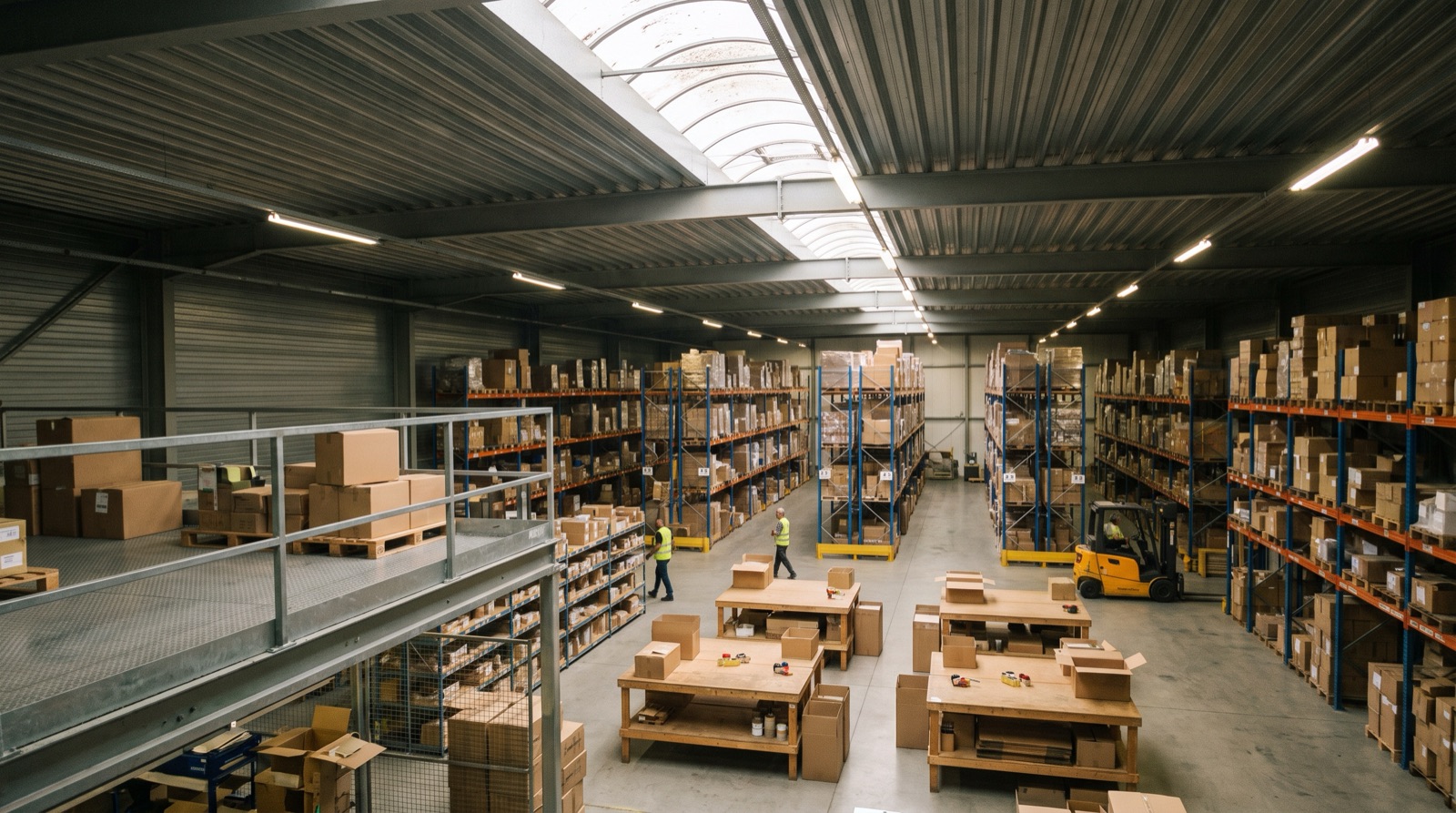
What is 3PL? It is short for third-party logistics: an outside company that stores your stock, packs your orders and ships them to your customers. You own the goods and you sell them. The 3PL does the physical work in between, in its own warehouse, and charges you for it.
For a brand in the United States, the United Kingdom or Australia, a 3PL is also the usual way to hold stock in Europe without opening a warehouse there.
3PL stands for third-party logistics. A 3PL is a company that receives your inventory, stores it, picks and packs each order, ships it and processes returns, without ever owning the goods. A 4PL sits one level up: it manages several logistics providers on your behalf and often runs no warehouse of its own. A growing online brand usually needs a 3PL first. In Europe, a 3PL inside the EU customs union lets your stock clear customs once, in bulk.
What changed in 2026 for brands that ship into Europe
Two EU decisions this year change the sums behind shipping each order from home. From 1 July 2026 until 1 July 2028, the EU applies a temporary customs duty of EUR 3 per item to goods in consignments worth up to EUR 150 imported from outside the EU.
Then, on 16 September 2026, the European Parliament and the Council adopted a reform of the EU Customs Union. The Commission states that the reform puts responsibility for customs formalities, duty payments and product compliance on non-EU online platforms and sellers, and that its new EU Customs Data Hub becomes mandatory for ecommerce on 1 July 2028.
Both changes make it worth comparing parcel-by-parcel imports with bulk stock held in Europe, which is the job a European 3PL does.
What is 3PL? The meaning of third-party logistics
3PL means third-party logistics. In the numbering the logistics trade uses, the first party is the business that owns the goods and the second party is the carrier that moves them. A third party takes over storage and order handling for the owner and works with the carriers on its behalf.
The term covers both the service and the company that provides it. In ecommerce, people usually mean a fulfillment company: a warehouse that holds stock for many brands and ships their online orders.
The key feature is ownership. A 3PL never buys your goods. You keep the inventory, the customer and the sales price, and the 3PL is paid for the work it does on your stock.
What a 3PL does for an online brand
A 3PL runs the chain from the moment your stock arrives to the moment a return goes back on the shelf. The core services look like this:
- Receiving. Your pallets or cartons are counted against your shipping notice, checked for damage and entered in the warehouse management system (WMS).
- Storage. Each product gets a location on a rack, shelf or bin, and the WMS tracks stock levels in real time.
- Pick and pack. When an order comes in from your store, staff or robots collect the items, pack them and print the label. The guide to pick and pack fulfillment walks through each step.
- Shipping. The 3PL hands parcels to carriers, often on its own carrier contracts, and sends tracking details back to your store.
- Returns. Returned items are received, inspected and restocked or set aside according to your rules.
- Value-added work. Bundling, gift sets, inserts and relabeling. Building several products into one sellable unit is called kitting.
- Customs and import help. Some 3PLs clear your inbound stock or work with a customs partner who does. Not all do, so ask.
The directory gives a sense of how common each service is. Of the 1,665 companies listed here, 1,286 state that they store stock and pick, pack and ship online orders for other businesses. 967 state that they process returns, 855 offer kitting or another value-added service, and 446 state that they arrange customs clearance or import paperwork for clients.
1PL, 2PL, 3PL, 4PL and 5PL in plain terms
The numbers describe how much of the logistics work you hand to someone else. They are trade shorthand, not legal categories, so providers use them loosely.
| Level | Who does the work | Example for an online brand |
|---|---|---|
| 1PL | You, with your own staff and space | Packing orders in your garage or your own warehouse |
| 2PL | A carrier that moves goods it does not store | A parcel company or trucking firm |
| 3PL | An outside company that stores, packs and ships for you | A fulfillment warehouse holding your stock |
| 4PL | A manager that runs several providers for you | One contact coordinating your 3PLs, carriers and forwarders |
| 5PL | A provider planning whole supply networks | Usually large retailers and manufacturers |
5PL has no settled meaning. For a brand placing its first stock abroad, the useful split is 3PL vs 4PL.
3PL vs 4PL: the difference that matters
A 3PL does the physical work. A 4PL manages the people who do it. That is the whole distinction, and it decides which one you call first.
| 3PL | 4PL | |
|---|---|---|
| Main job | Stores, picks, packs and ships your goods | Plans and coordinates your logistics providers |
| Runs a warehouse | Yes, its own or a network | Often not |
| Who you deal with | The warehouse team and account manager | One manager above several providers |
| Suits | Brands that need orders shipped | Larger companies with many sites, carriers and markets |
A 3PL with warehouses in several countries is still a 3PL. In this directory, 288 companies name warehouses or fulfillment centers of their own or of partners in at least two countries. Three examples show the range:
- euShipments.com (eushipments.com) in Ruse, Bulgaria, combines a network of 18 fulfillment centers across Europe and more than 60 courier companies under one contract.
- Biz Courier & Logistics (fulfillmentbybiz.com) in Koropi, Greece, runs seven European fulfillment centers serving 20 EU markets.
- ID Logistics (id-logistics.com) in Tilburg is part of a contract logistics group and runs seven hubs in the Netherlands and Belgium.
A 4PL would sit above companies like these and manage them for you. An online brand rarely needs that layer until it runs several 3PLs at once.
3PL vs fulfillment center vs freight forwarder
These three terms get mixed up, and the difference shows up on the quote.
Fulfillment center
A fulfillment center is a building: a warehouse set up to ship single orders to consumers. A 3PL is a company that may run one fulfillment center or many. Some brands and marketplaces run their own fulfillment centers and are not 3PLs at all. The term names what the building does; “3PL” names who it works for.
Freight forwarder
A freight forwarder arranges the transport of goods, usually in bulk and across borders. It books space on ships, planes and trucks, prepares shipping documents and often arranges customs clearance through a broker. It does not usually store your stock or pack single orders. For an overseas brand, the forwarder moves the pallets to Europe and the 3PL takes over at the warehouse door.
What EU law calls a 3PL
EU law has its own term for the warehouse side. Regulation (EU) 2019/1020, Article 3(11), defines a “fulfilment service provider” as a business offering at least two of four services (warehousing, packaging, addressing and dispatching) without owning the products. The same definition excludes postal services, parcel delivery services and freight transport services. In the EU’s terms, a carrier or a forwarder is not a fulfillment provider, and a typical ecommerce 3PL is one.
When a brand moves from in-house fulfillment to a 3PL
There is no order count that makes the switch right for everyone. These are the signs that usually prompt it:
- Packing takes your week. You or your team spend more time on boxes and labels than on product, marketing or customers.
- You have run out of room. Stock has spread from a spare room to a rented unit, and the next step is a lease.
- You sell in a market far from home. Shipping each order across an ocean adds customs paperwork and duty to every parcel.
- You sell on several channels. Your store, Amazon and wholesale buyers all draw on the same stock, and keeping counts in sync by hand has stopped working.
The last two are where a European 3PL earns its place for overseas brands. The guide to 3PL for small business covers the size question in more detail.
What a 3PL in Europe means for an overseas brand
The work inside a European warehouse is the same as anywhere else. What changes is the customs border. The EU’s 27 member states form a customs union. Once goods have cleared customs on entry, the Commission says, “no more customs duties are due, and no more customs checks are conducted”. A 3PL in one member state can ship to customers in the others without a customs border on each parcel.
Four rules shape the setup:
- VAT applies to every import. The EU abolished the VAT exemption for imported goods below EUR 22 on 1 July 2021, so all imported goods are subject to VAT, whatever their value.
- Low-value parcels now carry duty. The EUR 3 per item duty described above applies to goods in consignments up to EUR 150, from 1 July 2026 until 1 July 2028.
- Someone in the EU answers for product safety. Since 13 December 2024, the General Product Safety Regulation has required a responsible economic operator in the EU for each product it covers: an EU manufacturer, an importer, an authorized representative or a fulfillment service provider. A 3PL does not take on that role just by storing your goods.
- The UK is outside the EU customs union. GOV.UK states that the UK has left the EU Single Market and Customs Union, so a UK warehouse and an EU warehouse serve different customs territories.
Who acts as importer, who pays import VAT and which registrations you need depend on your own business. Ask the 3PL’s customs partner or a tax adviser, and get the answer in writing. The pillar guide on importing into the EU sets out the customs, VAT and duty steps in order.
Only some providers build their service around brands from outside the EU. In this directory, 45 companies state that they serve brands or sellers based outside the EU, and they are grouped on the page for EU fulfillment for US, UK and Australian brands.
FAQ
What does 3PL stand for?
3PL stands for third-party logistics. It describes a company that handles storage, order fulfillment and shipping for another business, which keeps ownership of the goods. In ecommerce, “a 3PL” usually means a fulfillment warehouse that serves many online brands.
What is 3PL and 4PL?
A 3PL does the physical logistics work: it stores your stock and ships your orders. A 4PL manages logistics providers on your behalf, such as several 3PLs and carriers, and often runs no warehouse itself. An online brand usually starts with a 3PL and considers a 4PL only once it runs several.
Is Amazon a 3PL?
For sellers on its marketplace, Fulfillment by Amazon works much like a 3PL. Amazon says sellers send products into its network of fulfillment centers, and it picks, packs and ships orders and handles customer service and returns. It is built around Amazon’s own store, so brands selling on several channels often use an independent 3PL as well. The directory lists Amazon and marketplace fulfillment companies separately.
What is an example of a 3PL company?
Any warehouse that stores and ships orders for brands it does not own is a 3PL. This directory lists 1,665 logistics companies across 30 European countries, and 1,286 of them state that they pick, pack and ship online orders for other businesses. The country-by-country list for Europe shows them by location.
Verdict: what is 3PL worth to an overseas brand?
A 3PL rents you a warehouse, a team and carrier connections without you building any of them. For a brand selling into Europe from the United States, the United Kingdom or Australia, it also moves your stock inside the EU customs union, so customs is handled once per shipment of stock and not once per order.
Start with a 3PL, not a 4PL. Pick one that connects to your store, handles your product type and can answer the customs questions in writing. The hub guide to choosing a 3PL in Europe walks through that in seven steps. Your next step is to open the list of fulfillment companies in Europe, choose the country where most of your buyers live, and contact two or three providers.