
What Is Kitting in Fulfillment? Meaning, Process and Uses
Kitting means building several items into one ready-to-ship unit under one SKU. How it differs from bundling, how a warehouse runs it, and what to prepare.
 By Andrew Calloway, editor
Published October 5, 2026 · Updated October 9, 2026
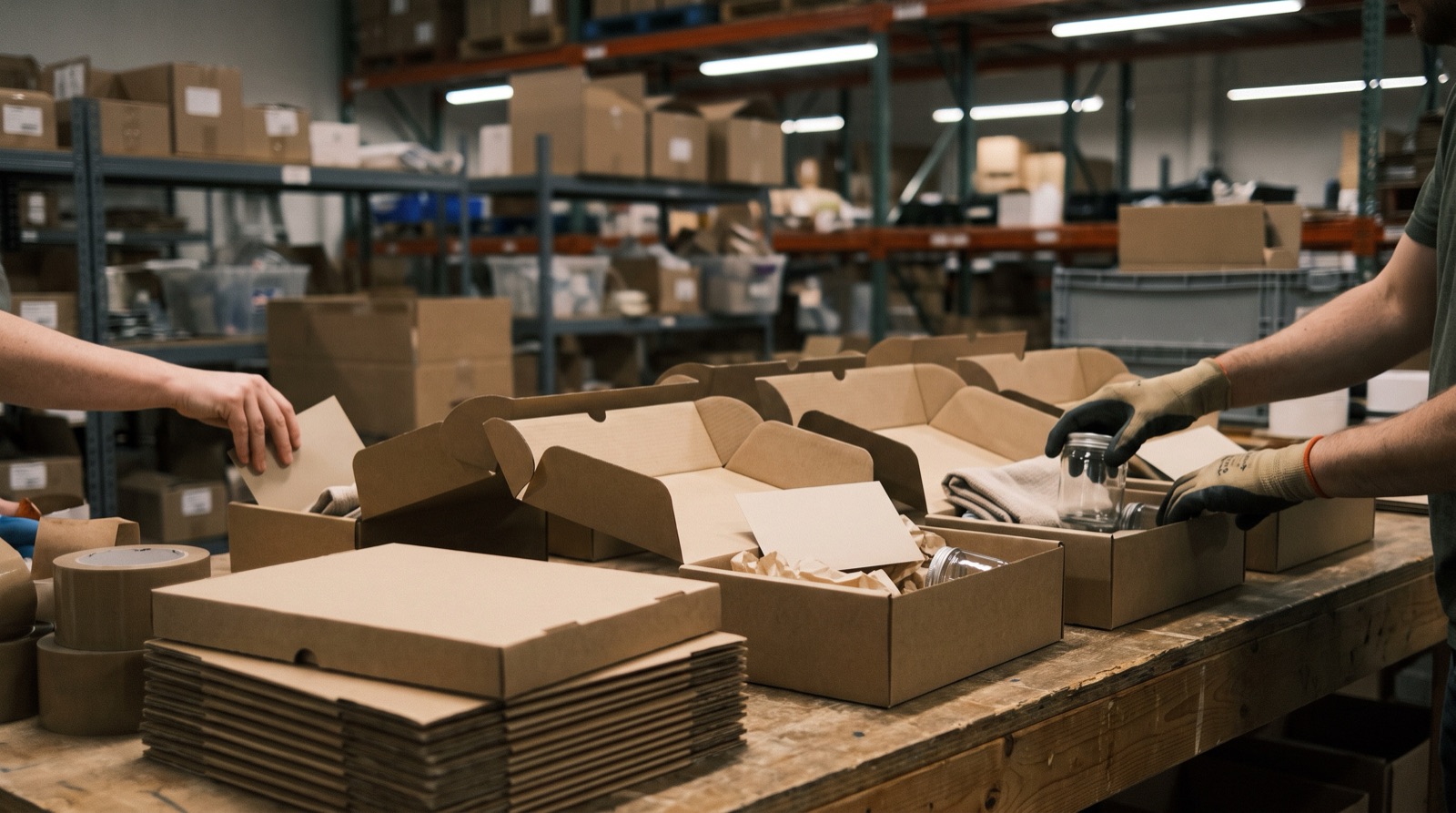
Kitting is the warehouse work of putting several separate items together into one ready-to-ship unit that is sold under its own SKU. A skincare starter set, a subscription box and a launch box for influencers are all kits. The warehouse builds them before the orders arrive, so each one ships like a single product.
For an online brand, kitting is one of the first services you add on top of pick and pack. If you sell from the United States, the United Kingdom or Australia and hold stock in Europe, a few EU rules follow the kit too. Below: what the term means, how it differs from bundling, how the process runs and what to prepare.
Kitting means pre-assembling separate items into one unit with its own SKU before orders arrive, so the warehouse picks one finished kit instead of several loose parts. Bundling usually means selling items together but picking them separately at order time. Typical kits are subscription boxes, gift sets, starter kits and PR boxes. Before asking for a quote, prepare a bill of materials, packaging specs, a volume forecast and a lead time.
What kitting means in a warehouse
In a warehouse, kitting turns components into a finished product that has its own stock count. Each kit is defined by a bill of materials (BOM): the list of component SKUs and quantities that make one unit. A “summer starter kit” might be one cleanser, one sunscreen, one travel pouch and one printed card.
The warehouse management system (WMS) holds the kit SKU and the BOM. When staff build 500 kits, the system takes the components out of stock and adds 500 kits. Your store then sells the kit SKU, and the picker collects one item per kit, not four.
There are two ways to run it:
- Pre-kitting. Kits are built in batches ahead of demand and stored as finished units. It suits steady sellers, subscription runs and seasonal gift sets.
- Kitting on demand. The kit is assembled when an order arrives, from components held in stock. It suits kits with many variants, such as a “build your own” set, where pre-building every combination makes no sense.
Kitting vs bundling vs assembly
Providers do not all use these words the same way. In common use they mean this:
| What happens | When it happens | Stock is counted as | |
|---|---|---|---|
| Kitting | Separate items are packed into one unit with its own SKU | Usually before the order, in batches | Finished kits |
| Bundling | Items are sold together under one listing but picked as separate SKUs | At order time | The individual items |
| Assembly | Parts are joined or built into a working product | Before sale, usually in a work order | The finished product |
Bundling is a selling decision; kitting is a warehouse operation. A “buy two, get a pouch” offer is a bundle if the picker grabs three loose items for each order. It becomes a kit when the warehouse packs the three into one box in advance.
Light assembly, such as fitting a strap, is often quoted with kitting as “kitting and assembly”. Ask which tasks are included.
Examples of kitting for online brands
Kitting jobs for ecommerce brands often fall into these groups:
- Subscription boxes. A new set of items each month or quarter, each run with its own BOM.
- Gift sets. Seasonal sets built for holidays, with gift boxes, tissue and a card.
- Starter kits. An entry product plus accessories, so a new customer gets everything in one box.
- Influencer and PR boxes. Small runs with personal notes, early samples and branded packaging.
- Retail-ready packs. Multipacks or display units built to a retailer’s specification for wholesale orders.
- Samples and marketing packs. Sample sets for loyalty campaigns, trade fairs or contests.
The kitting process, step by step
A typical kitting job runs in this order.
- Set up the kit. You send the BOM, photos and build instructions. The provider creates the kit SKU in its WMS.
- Receive the components. Components arrive and are counted against your advance shipping notice. Ask how shortages are reported.
- Issue a work order. You or the provider set the quantity to build and the date it must be finished.
- Pick the components. Staff pick everything for the run and bring it to a kitting station or line.
- Build and check. Each kit is assembled in the same order every time. Ask whether the first kit is checked against your photo and how the rest of the batch is checked, by count or by weight.
- Seal and label. The kit is closed and gets its own barcode label, so it can be scanned as one unit.
- Update stock. The WMS deducts the components and adds the finished kits. Your store sees the new kit quantity.
- Ship and handle returns. Kits are picked and shipped like any single product. A returned kit is inspected, then restocked whole, broken down into components, or written off according to your rules.
From then on, a kit follows the normal pick and pack fulfillment flow.
How kitting services show up in a quote
Kitting is usually quoted as a value-added service, separate from storage and pick fees. Amounts vary by provider and kit, but expect some of these lines:
- Kit setup. A one-off charge to create the kit SKU, load the BOM and write the work instructions.
- Assembly per kit or per hour. Simple kits are often priced per unit. Complex or one-off kits are often priced by labor hour.
- Per-component handling. Some providers charge for each item that goes into the kit.
- Kitting materials. Gift boxes, inserts, tissue, stickers and void fill, if the provider supplies them.
- Quality checks. Extra checks beyond the standard count, such as weighing each kit.
- Rework and de-kitting. Taking kits apart to change a component or to return parts to stock.
- Minimum run or rush charges. For small batches or work orders with a short deadline.
Send each provider the same BOM, kit photo and run sizes, then compare the total for a whole run, not the per-kit line alone.
Kitting for the European market: the rules that follow the kit
A kit sold in the EU as one product under your brand carries its own obligations. These are the rules; have a regulatory adviser or customs broker confirm what applies to you.
Product safety. Under the General Product Safety Regulation, anyone who places a product on the market under their own name or trademark is treated as its manufacturer (Article 13(1)). Manufacturers must give the product a type, batch or serial number. They must also show their name and postal and electronic address on the product, or on its packaging or an accompanying document where that is not possible (Article 9(5) and 9(6)). If you are the kit’s manufacturer under that rule, those details belong on the kit, its box or an enclosed document. For online sales, Article 19 requires the listing itself to show the manufacturer, a product identifier and a picture. Where the manufacturer is outside the EU, the listing must also name the responsible person in the EU. The GPSR guide for non-EU sellers explains that role.
Packaging. The EU packaging regulation, Regulation (EU) 2025/40, applies from 12 August 2026. Its definition of manufacturer covers a business that has a packaged product designed or manufactured under its own name or trademark. Article 24 caps the empty space in grouped, transport and e-commerce packaging at 50%, from 1 January 2030 or three years after the Commission’s rules on the calculation method take effect, whichever is later. That method must allow for packaging that holds more than one sales package or product, which is what a shipped kit often is.
Cosmetics sets. The items in a beauty gift set are still cosmetic products. Under Regulation (EC) No 1223/2009, a cosmetic product can be placed on the EU market only if a responsible person is designated within the EU. The cosmetics and supplement fulfillment companies list providers that state they handle these products.
Customs. Where you build the kit can change how it is classified on import. EU guidelines on classifying goods put up in sets for retail sale say a set needs at least two articles classifiable in different headings, put up together for a particular need or activity, and packed for sale without repacking. The items must also be presented on the same declaration and, as a rule, in the same package. A gift presentation alone does not make a set. Components shipped loose and kitted inside the EU do not meet those conditions on import, so each one is classified on its own. Ask your customs broker how your kit would be classified before you decide where to build it. The guide to importing into the EU covers the rest of the import process.
Kitting services in Europe: who offers them
Kitting is common in this directory. Of the 1,665 companies listed, 855 state that they offer kitting, assembly, bundling, relabeling or another value-added service, and 229 name kitting itself in their listing. Three examples from different countries show the range:
- Onefulfillment GmbH (onefulfillment.de) in Herbolzheim, Germany, lists custom packaging, personalized inserts, display building and contract assembly among its value-added work. Subscription boxes, cosmetics and beauty are among its sectors. It is rated 4.9 from 56 Google reviews.
- Groupe Routage (groupe-routage.fr) in Crouy, France, combines direct mail with logistics. It lists co-packing and kitting, ships samples for loyalty campaigns and contests, and works from three 5,000 m2 buildings with a 400 m2 packing room. It is rated 4.8 from 84 Google reviews.
- Systemise Fulfilment (systemisefulfilment.co.uk) in Scunthorpe, England, lists kitting and rework, subscription boxes and Amazon FBA prep. It is part of a group with hubs in the UK, the EU and the US. The UK is outside the EU customs union. It is rated 4.9 from 116 Google reviews.
These are examples, not a ranking. The list of fulfillment companies in Europe shows every provider by country.
What to prepare before you ask for kitting services
Have these ready before the first call:
- Bill of materials. Every component SKU and quantity per kit, with the barcode each one carries.
- A sample kit or photos. A finished kit, or clear photos of each layer, plus written build steps.
- Packaging specs. Box sizes, inserts and void fill, and who supplies each item. Say whether the kit box is also the shipping box.
- Volumes. Units per run, runs per year and your peak months.
- Lead time. When components arrive and when kits must be ready to ship.
- Labeling. Where the kit barcode goes, and whether the box needs the manufacturer and product details covered above.
- Return rules. Whether returned kits are restocked whole, broken down or written off.
The hub guide to choosing a 3PL in Europe covers the wider checks, and the explainer on what a 3PL is covers the basics of outsourcing.
FAQ
What do you mean by kitting?
Kitting means combining separate items into one unit that is stored, sold and shipped under a single SKU. The warehouse builds kits in advance from a bill of materials, so each order needs one pick instead of several.
What is kitting in a warehouse?
It is a value-added task: staff pick a kit’s components, assemble them at a kitting station, then check, seal and barcode the result. The warehouse system deducts the components and adds finished kits to stock.
How does kitting work in retail?
In retail, kitting turns several products into one sellable pack, such as a multipack, gift set or display unit. The brand defines the contents, the warehouse builds the packs in batches, and the retailer receives finished units ready for the shelf.
Can you give me an example of kitting?
A skincare brand sells a travel set with a cleanser, a moisturizer, a pouch and a card. The warehouse builds 1,000 sets in one run, labels each with its own barcode and stores them. Each order needs one pick.
What are the challenges of kitting?
The main risks are component shortages, which stop a whole run, and build errors repeated across a batch. Forecasting is harder because stock is split between components and finished kits. Clear instructions and a checked first kit reduce both.
Verdict: when kitting is worth it
Kitting is worth it when the same combination of items sells again and again, or when presentation is part of the product, as with gift sets and PR boxes. If your combinations change with every order, bundling at order time is usually simpler.
For a brand selling into Europe, treat each kit as a product in its own right, with a SKU, a bill of materials and labeling that meets EU product rules. Your next step is to open the list of fulfillment companies in Europe and ask the providers in your chosen country how they would run your first kitting job.